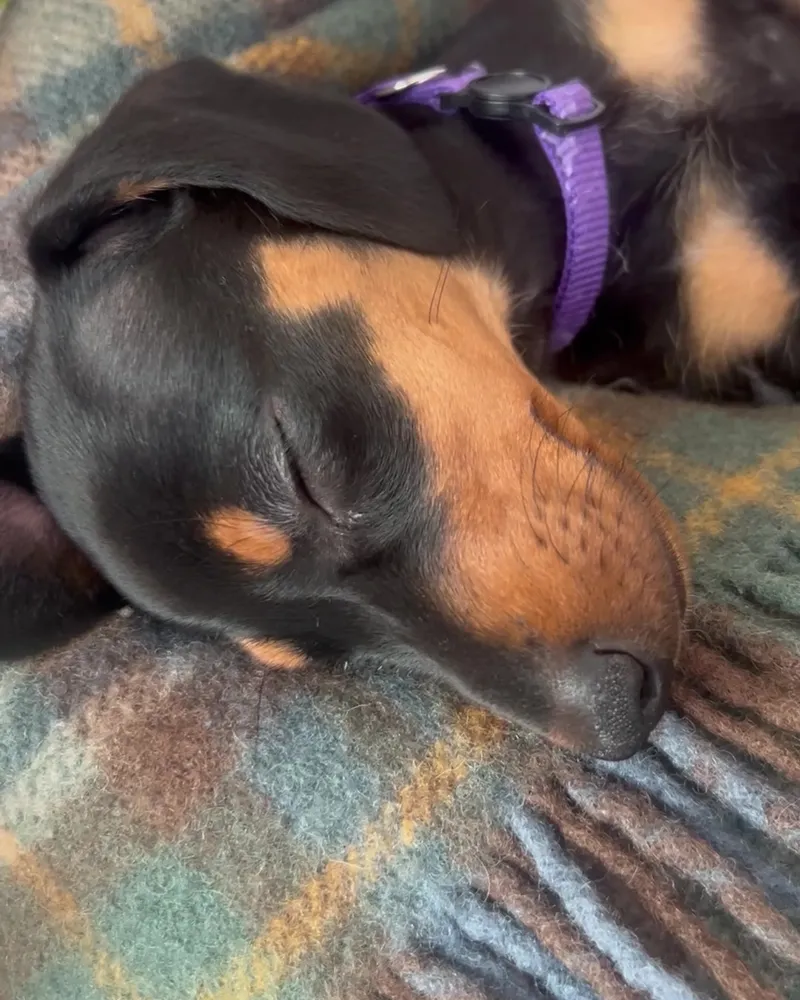
Imagine your dachshund's first birthday
- You sleep through the night, and so does your dog.
- Your dog goes to the door when it needs to go out, and the rug has been clean for months.
- The doorbell rings and you get one bark instead of ten minutes of it.
You've probably tried hard to get this right already
You read the books, joined the dachshund groups, and asked the breeder, the vet and the neighbor with the old dachshund. Everyone told you something different, and most of it sounded sensible.
- Start potty training on day one. Or wait until twelve weeks.
- Use a crate. Or never use a crate.
- Put ramps everywhere. Or let them jump.
Owners describe it like this:
"I read so many dachshund specific training books before we even got her but now I’m feeling very overwhelmed and can’t really figure out how to build a schedule to train her […]"
"Is this just a stubborn dachshund thing? Separation anxiety? Bad habits we accidentally reinforced?"
"[…] she told me dachshunds never really get potty trained. Is this true ? Is there no hope ? :("
And somewhere around the fifth puddle, a thought creeps in: maybe dachshunds really are just too stubborn.
Your dachshund isn't too stubborn. The advice is arriving in the wrong week.
Dachshunds were bred to go underground on their own and make decisions down there without anyone telling them what to do. That independence is what the breed was made for. Pressure tends to make a dachshund dig in, and a good reason to cooperate works much better.
The second part is timing. A puppy's first year runs in windows, and the same advice works in one and falls flat in another:
- The first three months are the most important time for socialization, according to the American Veterinary Society of Animal Behavior. What your puppy meets calmly now is much less likely to frighten it later.
- Around four to six months the adult teeth come in. Chewing is a need then, not bad behavior.
- Around eight months comes a teenage phase. In a study of 285 young guide dogs, they listened to their own person less at about eight months, and by twelve months they were back to normal or better. It's the "back to square one" moment so many owners post about.
Potty rules that work at fourteen weeks are too much at nine. Meeting new people is easy at ten weeks and much harder at six months. So the question that helps is a small one: what does my puppy need this week?
Introducing
The First-Year Dachshund Plan
It's built on the Right-Week Method: one short page for every week until your puppy is 16 weeks old, then one for every month until the first birthday. Each page has three parts:
- This week: what's going on with your puppy at this age
- Do this: one thing, about five minutes a day
- Watch for: the one sign that means something needs attention
You don't have to plan anything or read a whole book. You open the page for your puppy's age and do the one thing on it.
There is no version of this plan for any other breed. We only do dachshunds.
The first nights
This week: Your puppy needs 18 to 20 hours of sleep a day, and an overtired puppy bites more.
Do this: Keep one rhythm: sleep, out, eat, out, play, out, sleep.
Watch for: Crying when you lift it, or a hunched back. Call the vet.
One of the 17 pages
What each stage covers
Weeks 8 to 10: Home and the first nights
- The daily rhythm that calms most evening "land shark" attacks
- Where your puppy sleeps the first nights, and what to do at 2 a.m.
- Potty breaks: 8 to 10 a day at this age, and exactly when
- How to lift a dachshund: chest and hindquarters, every time
Weeks 10 to 12: The window
- Two or three new things a day: people, sounds, floors, the car
- The vet visit that's only for treats
- Paws, ears and mouth, so grooming and vet visits stay easy
Weeks 12 to 16: Biting, alone time and the doorbell
- A soft mouth, and what never to do (no holding the muzzle shut)
- The first minutes alone, built up slowly so your puppy stays calm
- The trade game that heads off food guarding before it starts
- Doorbell means "go to your bed", taught before the barking sets in
Months 4 to 6: Teeth, harness and nose
- What to give a teething dachshund to chew, and what to move out of reach
- Harness instead of collar for a long back
- A recall you never use up, and a long line until it works
- Nose games that tire a dachshund out better than running
Months 6 to 9: The teenage dip
- Why your trained dog suddenly isn't, and why it passes
- Going one step back without starting over
- First season or first marking: what changes
Months 9 to 12: The grown-up routine
- Building up daily walks for a strong back
- Keeping your dog lean, because extra weight is linked to more disc problems
- Why waiting past twelve months before neutering is worth asking your vet about
Back-safe habits run through every stage: carry your puppy on stairs and don't let it jump down from the sofa, bed or car while it's growing.
Who's behind this
I'm Nils. My family had a dachshund for about twelve years, and our own puppy, a black and tan smooth-haired girl born in August 2026, came home this October.
When she was nine weeks old, we sat down and wrote ourselves a plan for her first year: 54 pages on what matters at which age, what to do that week, and when something is a job for the vet. We wrote it for her first.
The First-Year Dachshund Plan is that plan, rewritten for other dachshund owners and shaped around the questions they actually ask. We went through 963 of their posts to find out where people get stuck.
I'm not a vet or a trainer. This plan puts what vets, breed experts and researchers say into the right order, one week at a time.


Why it's $27
A good puppy class costs around $120 for six to eight weeks, and owners say it's worth it. One wrote: "The 6-8 week class will cost about $120 but worth every penny." A class gives you one hour a week. This plan covers the other days, through the whole first year.
The First-Year Dachshund Plan
- 9 weekly pages (weeks 8 to 16) right away
- 8 monthly pages (months 5 to 12) by email, one a month
- Potty training, nights, biting, alone time, barking
- Back-safe habits in every stage
- Three printables included
$27
One-time payment
Unlock the Plan - $27Secure checkout
30-day money-back guarantee
If the plan doesn't help you and your puppy, send one email within 30 days and you get every cent back. No questions asked.
Plus three printables
- The Fridge Pages. Every stage on one printable page, so the whole family knows this week's one thing.
- The Back-Safe Home Check. Stairs, sofa, bed and car, checked in ten minutes, based on the UK Dachshund Breed Council's advice.
- The First Three Nights. What to do when your puppy cries in the crate, hour by hour.
It works for your dachshund if
- yours is a miniature or a standard
- the coat is smooth, long or wire-haired
- this is your first dachshund, or your first puppy in years
- you live in a house with a garden or in an apartment with stairs
- you work and your puppy has to stay alone for a few hours
Everything you get
- The First-Year Dachshund Plan: 9 weekly pages now, 8 monthly pages by email
- The Fridge Pages
- The Back-Safe Home Check
- The First Three Nights
- The sources for every page
- 30-day money-back guarantee
$27
One-time payment
Unlock the Plan - $27Secure checkout
Questions owners ask
My puppy is already five months old. Is it too late?
No. You start at the page for your puppy's age, and the plan tells you which earlier steps are still worth catching up on.
Isn't this just general puppy advice with "dachshund" on the cover?
No. Some of the guides you'll see in your feed are sold in the same format for a dozen different breeds. Advice that has to fit a Labrador, a Pug and a German Shepherd at the same time ends up general. This plan only exists for dachshunds and is built around what's different about them: a hunting dog that decides for itself, a long back, a small bladder and short legs that don't love wet grass.
Miniature or standard?
Both, and all three coats.
Is this veterinary advice?
No. Every page says when something is a question for your vet, and back pain always is.
How do I get it?
The weekly pages for weeks 8 to 16 come as a PDF right after you buy, for your phone and for printing. The monthly pages for months 5 to 12 follow by email, one each month.
What if it's not for us?
Send one email within 30 days and you get your money back.
Your puppy is only this age once
If you've read this far, you want to get this first year right. Start with the page for your puppy's age and the one thing on it.
The First-Year Dachshund Plan
$27
One-time payment · 30-day money-back guarantee
Unlock the Plan - $27Secure checkout